In nature, bare soil is surprisingly uncommon. Forest floors are blanketed by leaves, bark, fallen branches, and decomposing organic matter that shield the soil from heat, wind, erosion, and rapid moisture loss. Healthy gardens function best when we imitate those same natural systems — and that starts with the layer many gardeners overlook entirely.
Mulch.
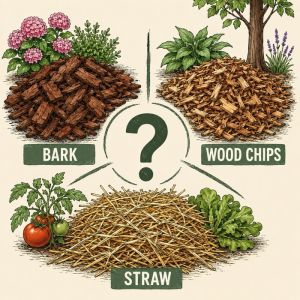
Not all mulch behaves the same way. Bark, wood chips, and straw each affect moisture retention, weed suppression, soil biology, and long-term soil structure differently. Choosing the right one for the right place can dramatically improve plant health, reduce maintenance, and build better soil year after year.
Bark Mulch — The Ornamental Garden Standard
Bark mulch is what most people picture when they think of mulch. It’s widely used in landscaped beds because of its uniform appearance, rich color, and tidy finish — and it performs well in the right setting.
Bark breaks down relatively slowly, making it excellent at:
- Reducing evaporation from the soil surface
- Moderating soil temperature swings through summer and winter
- Suppressing weed germination
- Preventing erosion in sloped beds
Bark mulch is the best choice for foundation plantings, ornamental flower beds, formal gardens, and front yard landscapes where appearance matters as much as function.
Its limitation is biological. Bark is primarily protective rather than actively soil-building. It contributes organic matter slowly and supports less fungal diversity than mixed wood chips. In vegetable gardens, bark can compact and become water-repellent over time — not ideal when you need consistent moisture around annual crops.
How deep to apply bark mulch
Apply 2–3 inches for ornamental beds. Deeper than 4 inches risks waterlogging and can prevent rain from reaching the root zone. Refresh annually in spring as the layer compresses and thins.
Wood Chips — The Soil Builder
Wood chips are a fundamentally different product to bark mulch — and one of the most underappreciated materials in the garden.
Fresh arborist wood chips typically contain a mixture of shredded branches, leaves, bark, cambium, and small twigs. That biological diversity is exactly what makes them so valuable. Over time, wood chips feed fungi, earthworms, and soil organisms while gradually improving soil structure from the surface down.
Wood chips excel around trees, shrubs, orchards, perennial beds, pathways, and drought-tolerant landscapes — anywhere long-term soil building matters more than a tidy finish.
In clay-heavy soils especially, the improvement over several seasons can be dramatic. The chips slowly decompose into darker, looser, more biologically active soil underneath — often with noticeably increased earthworm populations.
How deep to apply wood chips
Apply 4–6 inches for maximum weed suppression and moisture retention around trees and shrubs. For perennial beds, 3–4 inches is sufficient. Allow chips to settle before assessing — fresh chips compress significantly in the first few weeks.
🌿 MASTER GARDENER TIP
The “wood chips steal nitrogen” concern is one of the most persistent myths in gardening. In reality, surface-applied wood chips rarely create meaningful nitrogen deficiencies in established plantings. Decomposition happens primarily at the chip-to-soil interface — not deep in the root zone where your plants are feeding. The risk is greatest when chips are dug or tilled into the soil rather than left on the surface. Leave them on top and let them work naturally.
Straw — The Vegetable Garden Favorite
Straw has been used in vegetable gardens for generations — and for good reason. It is lightweight, breathable, and easy to spread. It regulates soil moisture exceptionally well around annual crops, and it breaks down over the course of a growing season and feeds the soil as it does.
In vegetable beds, straw delivers several benefits at once:
- Dramatically reduces evaporation during hot summer weather
- Keeps soil temperatures more stable — reducing the wet-dry cycles that cause tomato splitting and blossom end rot
- Prevents soil from splashing onto lower leaves during irrigation and rainfall, reducing common disease problems
- Keeps fruit like strawberries, courgettes, and squash clean and off the bare soil
- Breaks down into organic matter that improves soil structure over the season
Straw performs best in raised beds, tomato gardens, pepper beds, squash plantings, and pathways between vegetable rows.
How deep to apply straw mulch
Apply 3–4 inches around vegetable plants. Straw compresses quickly and will need topping up mid-season as it breaks down. In hot climates, a thicker initial layer of 4–5 inches holds moisture better through peak summer heat.
Straw vs hay — a critical difference
This distinction matters enormously and catches many gardeners out.
Straw is the dried stalks left after grain crops like wheat or barley have been harvested. The seed heads are gone. It contains very few viable seeds and is safe to use as mulch.
Hay is cut grass or legumes that still contain seed heads. Using hay as mulch can introduce thousands of weed seeds into your garden — and the resulting weed problem can take an entire season to bring back under control.
Always confirm you are buying straw, not hay, before applying it to vegetable beds. If in doubt, ask your supplier directly.
💡 DID YOU KNOW?
Free wood chips are often available from local tree surgeons and arborists who need to dispose of material after jobs. Fresh arborist chips — the kind with a mix of branches, bark, and leaves — are arguably the best wood chip mulch available, and in many areas you can get a truckload delivered at no cost simply by asking. Search for local arborists or check ChipDrop if you’re in the US.
What About Compost — Can You Use It as Mulch?
Many gardeners use compost as a mulch layer, but compost and mulch serve very different functions — and confusing the two is one of the most common mulching mistakes.
Compost is a soil amendment designed to feed soil biology and improve fertility. Mulch is a protective covering designed to regulate the environment around the soil surface.
When compost is applied as a thick mulch layer, several problems develop quickly:
- Weeds germinate rapidly — compost is a perfect growing medium
- The surface crusts over in heat and sheds water rather than absorbing it
- Moisture evaporates faster than from bark or straw
- Nutrients are exposed to sun and heavy rain and leach away
- The layer disappears into the soil within weeks
The most effective approach is to use compost beneath mulch rather than instead of it. A 1–2 inch layer of compost feeds the soil biology. A layer of bark, wood chips, or straw on top protects it. This mirrors what happens naturally in healthy ecosystems — organic matter breaks down beneath a protective covering rather than sitting exposed to the elements.
Which Mulch Is Best? A Quick Comparison
The right mulch depends entirely on what type of garden you’re building and what you need it to do.
| Mulch type | Best for | Depth | Soil building | Appearance | Cost |
|---|---|---|---|---|---|
| Bark mulch | Ornamental beds, formal landscapes | 2–3″ | Slow | Neat, uniform | Low–moderate |
| Wood chips | Trees, shrubs, perennial beds, pathways | 4–6″ | Excellent over time | Rustic, coarse | Free–low |
| Straw | Vegetable gardens, raised beds, tomatoes | 3–4″ | Moderate (seasonal) | Informal | Low |
| Compost | **Soil amendment under mulch only | 1–2″ | Excellent (immediate) | Fine, dark | Free–moderate |
Many established gardens use all three in different areas — bark in the front borders, wood chips under the fruit trees, straw in the vegetable beds. The combination produces the best results across the whole garden.
Mulch as Infrastructure — Not Decoration
From the ground up, mulch is not cosmetic. It is infrastructure.
The mulch layer regulates temperature, moisture, microbial activity, and soil stability. It protects the living ecosystem beneath the surface from the extremes that create plant stress — heat, drought, compaction, erosion, and the wet-dry cycles that cause problems like tomato splitting and blossom end rot.
Bare soil is often stressed soil. And stressed soil eventually produces stressed plants.
🌿 MASTER GARDENER TIPS
Keep mulch away from stems and trunks. Mulch piled directly against bark traps moisture against the wood, encouraging rot, fungal issues, and pest activity. Leave a clear gap of 2–3 inches around every trunk and stem — even in winter.
Water before applying mulch. Mulch preserves whatever moisture is already in the soil — but if the soil is dry when you apply it, it will trap that dryness in. Water deeply first, then mulch on top to lock that moisture in.
Refresh gradually, not all at once. Thin periodic additions are healthier than allowing mulch to compact into thick, dense layers over many seasons. Too much mulch can waterlog roots, block gas exchange in the soil, and create habitat for slugs and other pests.
Check what’s happening underneath. Lift the mulch layer occasionally and look at the soil beneath. In a healthy, well-functioning system you’ll see darker soil, increased earthworm activity, and improved moisture retention over time. That’s what you’re working toward.
Frequently Asked Questions
Can you use wood chips in a vegetable garden?
Yes, with caveats. Wood chips work well in the pathways between vegetable beds and around established perennial vegetables like asparagus and artichokes. They are less ideal directly around annual vegetable crops because their coarse texture can make transplanting and direct seeding difficult. For annual vegetable beds, straw is the better choice. Use wood chips to build the pathways and surround the beds, and straw within them.
Does bark mulch attract termites?
Bark mulch can provide habitat for termites in regions where they are prevalent, particularly when mulch is piled against wooden structures, fences, or house foundations. The risk is significantly reduced by keeping mulch at least 6 inches away from any wooden structures and avoiding thick piles against walls. In termite-prone areas, gravel or stone mulch near foundations is a safer option.
How deep should mulch be?
As a general rule: bark mulch 2–3 inches, wood chips 4–6 inches around trees and shrubs, straw 3–4 inches in vegetable beds. Deeper than these recommendations risks waterlogging, oxygen deprivation in the root zone, and slug habitat. Shallower than these recommendations and the mulch won’t retain moisture or suppress weeds effectively.
When is the best time to mulch?
Spring and autumn are the two best mulching windows. In spring, mulch after the soil has warmed up — mulching too early traps cold in the soil and slows growth. In autumn, mulch before the ground freezes to protect root systems and soil biology through winter. Avoid mulching frozen ground as it prevents the soil warming back up in spring.
Is colored or dyed bark mulch safe?
Most coloured bark mulch uses iron oxide or carbon-based dyes that are generally considered safe for garden use. The bigger concern with dyed mulch is the source material — some coloured mulch is made from recycled timber, pallets, or construction waste that may contain preservatives, paints, or other chemicals. For vegetable gardens especially, opt for natural undyed mulch from a reputable supplier.
Will mulch attract slugs and snails?
Any mulch that retains moisture can provide habitat for slugs and snails. The risk is manageable rather than a reason to avoid mulching altogether. Keep mulch pulled back slightly from the base of vulnerable plants, avoid excessively thick layers, and consider rough materials like bark or grit around slug-susceptible plants. The soil health and moisture benefits of mulching far outweigh the slug risk in most gardens. See our guide to natural snail control for more.
Final Thoughts
The right mulch in the right place is one of the highest-return investments you can make in your garden. It reduces watering, suppresses weeds, builds soil, and protects roots from the extremes of summer heat and winter cold — all without sprays, amendments, or significant ongoing effort.
If you’re starting today, here’s where to begin:
- Water all beds deeply before applying anything
- Add straw to your vegetable beds — 3–4 inches, away from stems
- Apply bark or wood chips to ornamental and perennial areas
- Contact a local arborist about free wood chip delivery for trees and pathways
- Check underneath your mulch in six weeks — the soil should already look darker and more active
Cover the soil. The rest follows.
Related reading: Why Tomatoes Split, Crack and Rot · Rust Fungus — Identification, Prevention and Treatment · Complete Guide to Organic Pest Control


More From Our Master Gardener





Special Gifts for Gardeners
Shop Our Gardening Gift Boxes

5 Star Reviews for Our Hori Hori

Recent Posts

How to Revive a Neglected Garden Bed: 12 Steps to Bring It Back
Curling Leaves: What Your Garden Is Trying to Tell You
Deadheading Guide: What to Deadhead & What to Leave Alone
Wood, Copper, or Stainless: The Best Garden Markers for Every Part of Your Garden

July Garden Signals: Yellow Leaves, Peony Aftercare & the Knee-High Rule