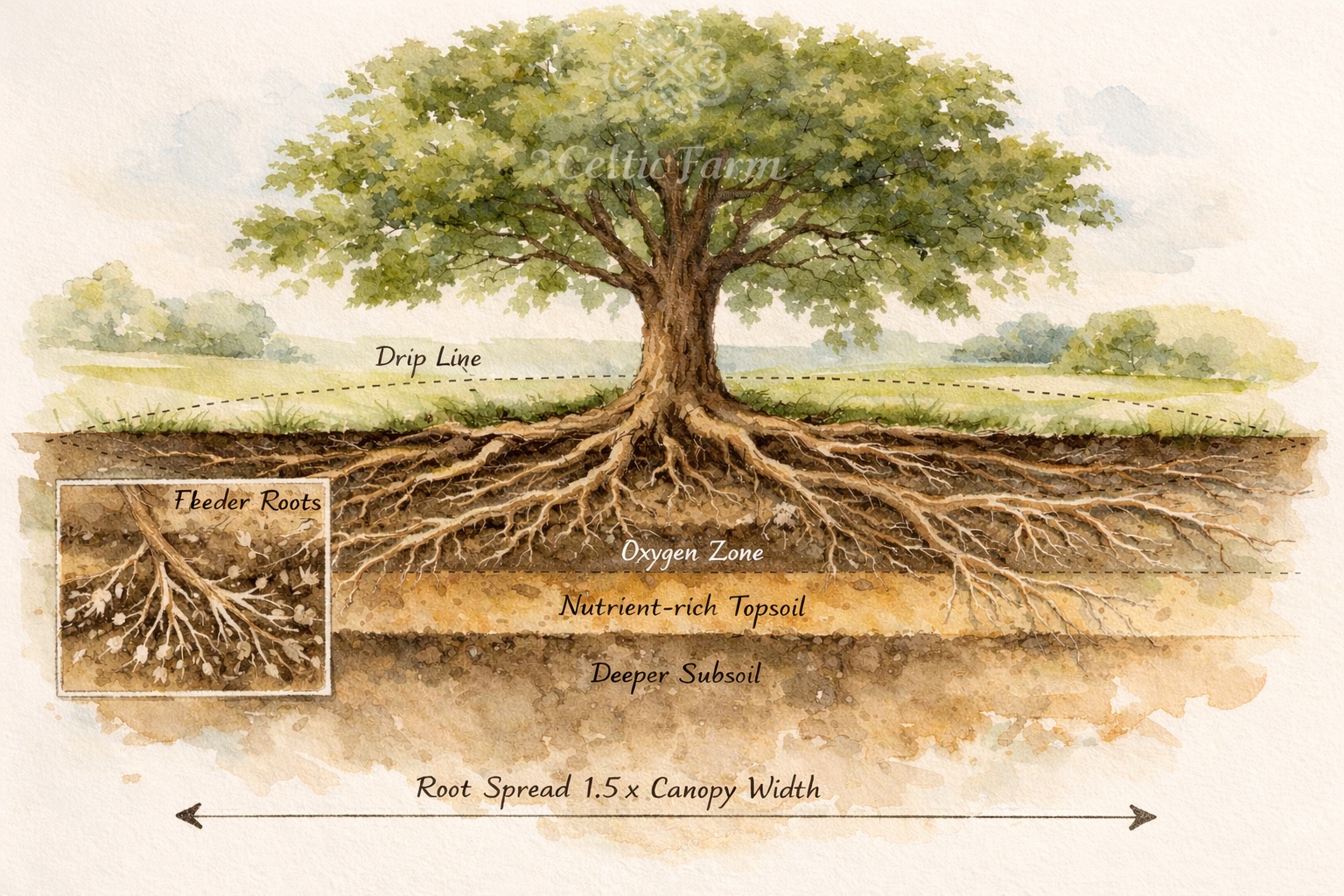
The Science of the “Oxygen Zone”
If you’ve ever transplanted a shrub, observed its growth over a season and wondered why the roots don’t immediately dive straight down, you’re not alone. We tend to picture roots like inverted trees — a deep central trunk anchoring the plant in a dramatic vertical plunge.
But that’s not how most roots behave.
In reality, roots grow sideways first.
Once you understand the physiological why behind this behavior, it changes how you dig planting holes, how you water, and how you build soil. At The Celtic Farm, we believe the best gardening starts with understanding the ecosystem beneath our feet.
The Myth of the Deep-First Root
The image of a single taproot driving deep into the earth is true for a few species — carrots, oaks, and dandelions in loose soil.
But for the vast majority of garden plants — vegetables, shrubs, perennials, and even many trees — the first major expansion is horizontal.
Why?
Because survival depends more on oxygen and biological access than depth.
Oxygen Lives Near the Surface
Roots do not just absorb water and nutrients.
They respire.
Every root cell requires oxygen to convert sugars into energy. Without oxygen, roots suffocate.
And oxygen is most available in the upper soil layers — where organic matter, air pockets, worm channels, and microbial life are concentrated.
- Soil becomes denser.
- Air movement slows.
- Oxygen declines.
- Anaerobic conditions can develop.
- Biological activity decreases.
Plants expand laterally first to occupy this oxygen-rich zone. This is where the biological engine lives. This is where the buffet is.
Master Gardener Tip – If you want healthier roots, improve aeration before adding fertilizer. Compacted soil suffocates plants faster than nutrient deficiency ever will.
Water Infiltration Favors the Surface Horizon
Rain and irrigation enter the soil from the top down.
In undisturbed soil, moisture lingers longest in the upper layers because organic matter acts like a sponge. Fine feeder roots — the microscopic hairs responsible for most nutrient uptake — develop in this zone to intercept water before it drains deeper.
Only once a plant establishes stability does it invest energy in deeper structural roots for long-term drought resilience.
But the first move is sideways.
Master Gardener Tip – Instead of watering lightly every day, soak the soil deeply and allow the top layer to dry slightly. This strengthens both lateral feeder roots and deeper anchoring roots over time.
Roots Follow Life, Not Gravity
While gravity influences root direction, roots respond more strongly to environmental gradients:
- Moisture gradients
- Nutrient concentrations
- Oxygen availability
- Mycorrhizal fungal networks
Roots do not chase depth for depth’s sake. They chase opportunity and resources for growth.
Did You Know?
More than 80 percent of a tree’s absorbing roots live in the top 18 inches of soil.
The dramatic vertical root systems we imagine are often an illusion. What stabilizes most plants is lateral spread.
The Long-Term Architecture — Wider Than You Think
Over time, a mature tree’s root system can extend 1.5 times the width of the canopy — and often farther.
If a tree has a 20-foot-wide canopy, its roots may stretch 30 feet or more across the soil surface — mostly within the upper 12–24 inches.
Master Gardener Note – Never assume the drip line marks the edge of the root zone. The true biological footprint of a tree is usually much wider.
This Changes How You Plant
The Golden Rule of planting makes scientific sense: dig two to three times wider than the root ball, but no deeper.
Master Gardener Tip: Rough up the sides of your planting hole. Smooth, glazed soil walls can redirect roots into circling patterns.
The Real Lesson
Roots do not grow downward first because they are not chasing depth. They are chasing life — oxygen, moisture, and microbial partnership.
When we understand that, we stop planting like we’re drilling wells. We start planting like we’re building ecosystems — from the ground out.
Master Your Garden
Explore our curated collection of tools and soil-supporting essentials designed to protect root zones and encourage resilient growth. Because strong gardens begin in the oxygen zone.


More From Our Master Gardener






Special Gifts for Gardeners
Shop Our Gardening Gift Boxes

5 Star Reviews for Our Hori Hori

Recent Posts


Deadheading Guide: What to Deadhead & What to Leave Alone

Wood, Copper, or Stainless: The Best Garden Markers for Every Part of Your Garden

July Garden Signals: Yellow Leaves, Peony Aftercare & the Knee-High Rule

Why Won’t My Soil Absorb Water? What Your Garden Is Trying to Tell You

What Dragonflies Are Telling You About Your Garden